

The Ultimate Guide to Udawalawe National Park, Sri Lanka
Are you planning a trip to Sri Lanka? If you love wildlife, seeing wild elephants in their natural habitat is probably at the top of your travel bucket list. Many tourists automatically book a safari at Yala National Park. However, Yala often suffers from heavy tourist crowds, and its narrow tracks can quickly fill up with too many safari jeeps. This congestion can ruin the peaceful feeling of being out in nature.
If you want a peaceful, authentic, and unhurried wildlife experience, you should choose Udawalawe National Park instead. Established in 1972, this sanctuary protects the wild animals that lost their homes when the massive Walawe Reservoir was built. The park features vast open plains, lush wetlands, and a large population of wild animals. It stands out as the perfect destination for a Udawalawe National Park safari because the open environment allows you to watch animals behave naturally without the stress of heavy tourist traffic. The park looks like an East African savannah with its wide grasslands and low shrubs, making it a dream location for open-air wildlife viewing and clear photography.
For travelers coming from Europe and the USA, finding a destination that balances adventure with high ethical standards is very important. Udawalawe satisfies this need perfectly by focusing heavily on habitat preservation and animal welfare. The local rangers work hard to protect the park boundaries from illegal poaching and to keep the environment clean. When you enter the gates, you instantly feel a sense of calm because the vast layout prevents vehicles from crowding around a single animal. This guide will provide you with complete, verified facts and helpful tips to ensure your journey into the wild is successful, safe, and deeply memorable.
Udawalawe vs Yala National Park: Which One is Better?
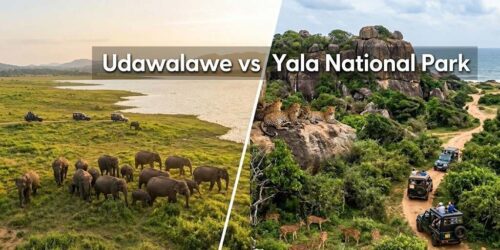
Side-by-side view: Udawalawe’s open elephant plains (left) versus Yala’s rocky leopard territory (right).
Choosing between these two famous national parks depends almost entirely on the specific animals you want to see during your vacation. Both parks are beautiful and protected by the Department of Wildlife Conservation, but they offer completely different environments and experiences for international travelers. Yala National Park is world-famous for its high density of Sri Lankan leopards, which draws thousands of eager tourists every single month. However, because leopards are solitary and excellent at hiding in dense brush, a safari in Yala can sometimes feel like a high-stakes, stressful treasure hunt where dozens of jeeps rush to a single spot at the same time.
In contrast, Udawalawe National Park is famous for its massive, stable herds of Asian elephants that roam freely across the grasslands. The landscape here consists of open plains, marshes, and a large central water reservoir rather than thick jungle bushes or rocky outcrops. This open ground is a major advantage for visitors because it makes spotting large groups of wildlife incredibly easy from far away. You do not have to drive around for hours hoping for a lucky glance; instead, you can sit quietly in your jeep and watch herds interact peacefully for long periods of time without another vehicle blocking your view.
Furthermore, the overall atmosphere and crowd behavior differ greatly between the two locations. Because Yala is so popular, the trails can quickly become congested, leading to loud engine noises and exhaust fumes that disturb both the tourists and the animals. Udawalawe maintains a much quieter, relaxed vibe where local drivers generally respect the animals and give them plenty of space to move around. If your main goal is to experience a peaceful, authentic, and ethical elephant safari in Sri Lanka, Udawalawe is clearly the better choice for your travel itinerary.
What to Expect on a Udawalawe National Park Safari
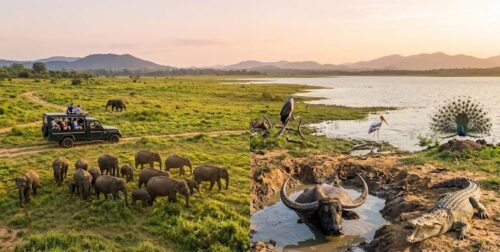
Exploring the diverse wildlife of Udawalawe: from majestic elephant clans (left) to water buffaloes, crocodiles, and peacocks by the reservoir (right).
According to official statistics from the Department of Wildlife Conservation in Sri Lanka, Udawalawe is home to a permanent resident population of roughly 250 to 500 wild Asian elephants. Because food and water are abundant, you will easily spot large families, known as clans, walking together across the open fields. It is truly amazing to watch the protective mothers travel slowly with their tiny, fluffy calves, teaching them how to pull up grass and use their trunks properly. The elephants are very accustomed to the presence of the safari jeeps, which means they often walk right past the vehicles without showing any signs of fear or anger.
The management of the park ensures that these magnificent creatures receive complete protection from human greed and interference. There are absolutely no chains, no training hooks, and no opportunities for tourists to ride or interact closely with the elephants inside the park boundaries. This strict hands-off approach ensures that the animals maintain their wild instincts and live healthy, natural lives, making your visit a genuinely ethical elephant safari in Sri Lanka. Western travelers appreciate this commitment to conservation, as it directly aligns with international animal welfare standards and promotes sustainable eco-tourism.
While the elephants are undoubtedly the main attraction, you will also encounter a rich variety of other wildlife during your three-hour jeep ride. Huge wild water buffaloes love to sit deep in the mud holes to stay cool during the heat of the day, with only their massive curved horns visible above the water. Large mugger crocodiles can be seen sunbathing peacefully on the muddy banks of the reservoir, keeping their mouths wide open to regulate their body temperature. If you look up into the trees or scan the tall grasses, you will spot colorful birds like grey-headed fish eagles, painted storks, and hundreds of wild peacocks displaying their vibrant feathers.
Udawalawe Elephant Transit Home Guide
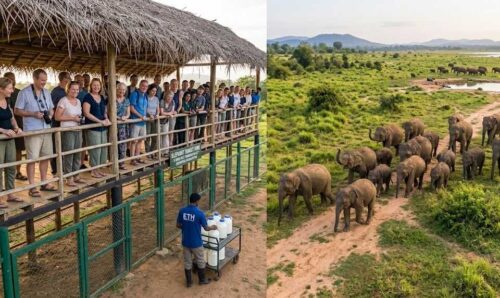
Visitors observe the milk preparation from a secure, elevated viewing platform at the Elephant Transit Home, ensuring a respectful and hands-off experience.
You should definitely plan to visit the Elephant Transit Home (ETH) either right before or immediately after your main safari ride. This special facility is located just a few minutes outside the main park gates and offers a unique look at wildlife rehabilitation. Supported directly by the international Born Free Foundation, this center serves as a gold standard for responsible animal care in Asia. The dedicated workers and veterinarians here rescue orphaned, injured, or sick baby elephants from various jungles and villages across Sri Lanka, bringing them to the center for medical treatment and daily care.
The ultimate goal of the Elephant Transit Home is to care for these vulnerable calves until they are strong and old enough to survive completely on their own. Once they reach about five years of age, the staff releases them back into the wild plains of Udawalawe National Park, where they can join existing wild herds. To make sure this transition is successful, the facility enforces a strict rule of zero human contact. Visitors are not allowed to pet, feed, wash, or walk with the babies, which prevents the elephants from becoming attached to humans or dependent on them for survival.
Feeding Times at the Transit Home:
9:00 AM | 12:00 PM | 3:00 PM | 6:00 PM
Instead of direct interaction, you will stand on a safe, elevated wooden viewing platform to watch the calves run out to the feeding station when the gates open. Watching thirty or forty hungry baby elephants enthusiastically stampede toward the caretakers for their giant bottles of milk is a heartwarming and joyful experience. The center opens to the public only during the scheduled feeding times, which happen every three hours throughout the day. Buying a modest entry ticket provides vital financial support, as the money goes directly toward purchasing milk powder, medical supplies, and food for these rescued babies.
Planning Your Trip: Best Time to Visit Udawalawe
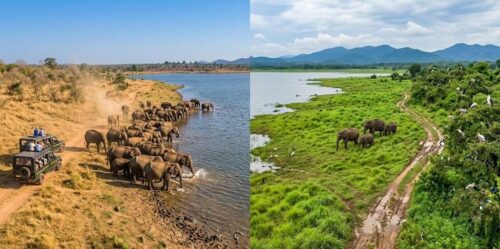
This side-by-side comparison captures Udawalawe National Park’s two distinct faces: the high-concentration elephant viewing of the dusty dry season (left) and the vibrant, lush, bird-rich landscape of the monsoon season (right).
You can successfully see elephants in Udawalawe National Park all year round because the central reservoir always holds a massive amount of water, ensuring the animals never have to migrate away. However, the changing seasonal weather patterns in Sri Lanka can affect your personal comfort and how easily you can spot the smaller animals. The region experiences distinct dry and wet periods, so matching your arrival with the correct season will help you get the absolute most out of your safari experience.
The absolute best time for maximum wildlife viewing occurs during the peak dry season, which runs from May to September. During these warm months, the smaller water holes scattered throughout the deep bush completely dry up, forcing hundreds of elephants to gather predictably around the edges of the main reservoir to drink, play, and bathe. The vegetation also thins out significantly during the dry season, removing hiding spots and making it incredibly simple to capture clear, unobstructed photographs of the animals from a distance.
Alternatively, the months from December to March offer excellent weather with clear blue skies and pleasant temperatures, making it a highly popular window for travelers from Europe and the USA who want to escape the freezing winter cold. This period also marks the arrival of thousands of beautiful migratory birds from the northern hemisphere, turning the park into a vibrant paradise for birdwatchers. The monsoon season peaks between October and November, bringing heavy rain showers that turn the landscape into a lush, emerald-green paradise; however, the dirt tracks can become very muddy and slippery, and the elephants tend to scatter because water is available everywhere.
Travel Tips for International Visitors

From purchasing entrance tickets with your local driver to planning the next coastal stop, this guide covers essential logistics for a smooth Udawalawe visit.
To ensure a smooth and enjoyable trip, it helps to understand the basic logistics and rules of the park before you arrive. According to official guidelines, entry tickets for foreign adults cost around $42 USD per person, though prices can fluctuate slightly depending on government tax updates and currency exchange rates. This fee goes directly to the Department of Wildlife Conservation to fund park maintenance and anti-poaching patrols. You will also need to hire a private, open-air 4WD safari jeep along with a local driver at the entrance gate, which is a fantastic way to support the local economy.
Udawalawe is perfectly located as a transition stop within a standard Sri Lankan travel itinerary, making it very easy to visit without wasting time. Most international tourists hire a private car or catch a tourist shuttle from the cool mountain town of Ella in the morning, arrive in Udawalawe in time for an exciting afternoon safari, and spend the night at a local eco-lodge or luxury tented campsite. The following morning, they can comfortably drive down to the famous southern surf beaches, such as Mirissa, Hiriketiya, or the historic city of Galle, in just a couple of hours.
When preparing for your ride, keep in mind that the safari jeeps are completely open on the sides to give you the best possible view of the animals. Because the dirt tracks become very dry and dusty when multiple jeeps are driving, it is highly recommended to bring a light cotton scarf or bandana to cover your mouth and nose. Additionally, you should wear comfortable, neutral-colored clothing such as green, khaki, brown, or grey so that you blend into the natural environment and do not startle the sensitive wildlife with bright neon colors. Don’t forget to pack a good pair of binoculars, plenty of sunscreen, and a camera with a strong zoom lens to capture the incredible animals from a safe, respectful distance.






 Expertise
 Quality trips honestly priced
 Environmentally friendly trips
 Freedom and choice
 Go beyond ordinary


